
Our Specialty
Hot water, handled — tank or tankless
Is it time to repair or replace your water heater? Whether your current unit needs attention or you're thinking of going green with tankless, JJB Plumbing has specialized in exactly this for 30+ years.
Installed to current California code — permit and inspection included
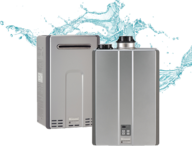
- Repair, replacement & new installation
- All major brands: Rinnai, Noritz, Navien & more
- Gas line upsizing & venting done in-house
- Annual tankless descaling service
Why go tankless?
Five reasons homeowners make the switch
Going tankless helps you make better use of the space in your home while saving on energy — with hot water that never runs out.
Unlimited hot water
Instantly available, and it won't run out during dishes or a bath.
Efficiency
No large tank kept constantly heated means less energy burned.
Space savings
Wall-hung and compact — reclaim a closet or garage corner.
Fewer repairs
No tank to corrode or leak; fewer failure points over its life.
Long lifespan
15–20+ years with simple annual maintenance.
Standard vs. tankless
An honest side-by-side
Both are good technologies — the right choice depends on your household, your home's setup, and your budget.
| Standard Tank | Tankless | |
|---|---|---|
| Hot water supply | Limited by tank size | Endless, on demand |
| Typical lifespan | 8–12 years | 15–20+ years |
| Energy use | Heats 24/7, standby loss | Heats only when needed |
| Space required | Full closet / garage corner | Wall-hung, suitcase-sized |
| Upfront cost | Lower | Higher (gas & venting work) |
| Maintenance | Annual flush recommended | Annual descale required |
Want the full breakdown? Read our honest tank vs. tankless comparison →
Repair or replace?
Signs your water heater is on its way out
Replace on your schedule — not the tank's. These are the signals we tell homeowners to watch for.
- It's past 10 years old (check the serial number date)
- Rusty or discolored water from the hot side only
- Rumbling or popping sounds — sediment buildup
- Moisture, drips, or corrosion around the tank
- Hot water runs out noticeably faster than it used to
How it works
From first call to hot shower
- 1
Call or message us
Describe your current setup and what's going on. We can often give you a ballpark on the spot.
- 2
Free on-site estimate
We verify sizing, gas supply, venting, and code items, then give you a clear, itemized price.
- 3
Installation day
Most replacements are done in a day — installed to current California code, old unit hauled away.
- 4
Permit & inspection
We pull the permit and meet the inspector, so the job is documented, safe, and resale-ready.
Water heater FAQs
Common questions, straight answers
A traditional tank water heater typically lasts 8–12 years in our area; tankless units commonly last 15–20+ years with annual maintenance. Hard water in the Roseville/Sacramento region shortens tank life if the unit is never flushed. If your tank is past 10 years old, it's smart to plan the replacement before it fails on its own schedule.
Our rule of thumb: if the tank itself is leaking, replacement is the only fix. If the unit is under ~8 years old and the problem is a component — thermocouple, element, gas valve, thermostat — a repair usually makes sense. Past 10 years, put repair money toward a new unit instead. We'll give you an honest recommendation either way; we repair plenty of water heaters we could have sold replacements for.
For many homes, yes: endless hot water, lower energy use, freed-up garage space, and roughly double the lifespan of a tank. The trade-off is a higher upfront cost, since conversions often need a larger gas line and new venting. If your household runs out of hot water, plans to stay in the home for years, or is remodeling anyway, tankless usually pencils out. We'll size it honestly — read our tank vs. tankless comparison or call for a free estimate.
Yes — an annual descale and flush is important in our hard-water area. Scale builds up on the heat exchanger, reducing efficiency and eventually triggering error codes or damage. The service takes about an hour when isolation valves are installed (we add them with every install). Skipping maintenance is the number-one cause of early tankless failures we see.
That's usually sediment: minerals from our hard water settle on the tank bottom, and steam bubbles popping through the layer cause the rumble. A flush can help if it's caught early. Left alone, sediment insulates the burner from the water, wastes gas, overheats the tank bottom, and shortens the unit's life. If your heater is noisy, have it looked at — it's often a sign it's working too hard.
Yes — water heater replacements require a permit in California, and the installation must meet current code: seismic strapping, a temperature & pressure relief drain line, proper venting, and often a thermal expansion tank. We handle the permit and install to code every time. It protects you at resale and, more importantly, keeps your home safe.
Call today for a free water heater estimate
Talk to the specialists — 916-501-6039. Same-week replacement in most cases.